In the third edition of IES Generative AI Challenge in 2026, we received more than 500 registrations from teams around the world. Shortlisted teams submitted 192 initial paper drafts at Milestone 2 and more than 180 final manuscripts at Milestone 3. 92 hackathon papers were accepted and presented at IRAI 2026, the IEEE International Conference on Responsible Artificial Intelligence, held in Melbourne, Australia, from 2 to 5 September 2026. 26 papers were presented in person and 66 online through the dedicated Hackathon Online Track.
Eight teams were selected as winners. Six were recognised at the IRAI 2026 Student and Young Professional Event and Awards Ceremony on 3 September 2026, and two teams, InverTrust AI and SummerGrid, won through the IECON 2026 track.
Winning teams
|
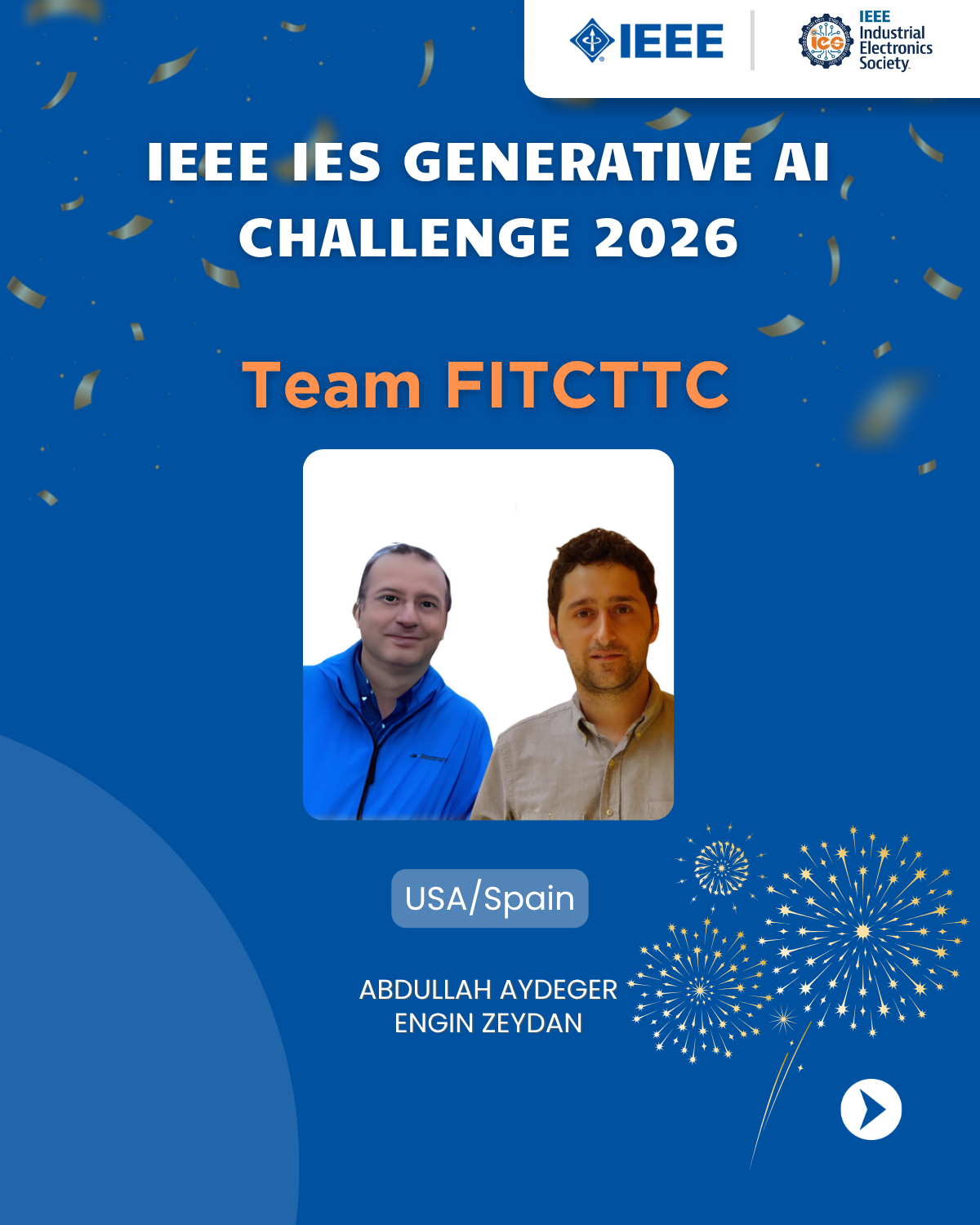
Data-Driven Cryptographic Agility with Bounded AI Decision Models for Industrial IoT Systems Industrial Internet of Things (IIoT) systems must secure communication under strict latency, energy, and reliability constraints while operating in environments where threat conditions, network load, and device capabilities change over time. Static cryptographic configurations, which are chosen at design time and remain fixed during operation, create a persistent mismatch between security provisioning and runtime needs. This paper presents a data-driven AI framework for cryptographic agility that observes runtime context and threat indicators, recommends an approved cryptographic profile through a bounded decision engine, validates the recommendation against security and timing constraints, and applies the selected profile through a controlled enforcement mechanism. We evaluate the framework through a simulation study comparing an adaptive AI-guided policy against three static baselines (lightweight, balanced, and strong) across 2,000 IIoT communication trials. The adaptive policy achieves 80.5% security compliance and 70.2% deadline satisfaction simultaneously, whereas each static alternative sacrifices one objective for the other. The strongest static policy reaches 100% security compliance but only 55.2% deadline satisfaction, while the lightweight policy achieves 75.1% deadline satisfaction but only 18.9% security compliance. A feature importance analysis reveals that threat level, deadline, and network latency are the dominant context factors guiding profile selection. These results demonstrate that bounded, context-aware cryptographic adaptation offers a more favorable multi-objective tradeoff than any single static configuration. Team: FITCTTC (USA/Spain)Team members: Abdullah Aydeger, Engin Zeydan |
|

|
LLM-Based Rapid Generation Method for Power Distribution Networks Service Restoration Service restoration is a key measure to improve the reliability of power supply in distribution networks. However, the increasingly complex topology of distribution networks and the widespread integration of new energy equipment make the service restoration problem more complex and difficult to solve due to the large number of decision variables. This paper explores the application of large language models (LLMs) in the vertical domain of service restoration, proposing a multi-stage decision-making method. Its key features include supervised fine-tuning of a local small-scale LLM to obtain a preliminary restoration scheme, zero-shot inference on an online large-scale LLM, and information enhancement of the restoration scheme by combining real-time information. Furthermore, a sample construction method for supervised fine-tuning of the local LLM is proposed, including original data selection, sample preparation and augmentation, and sample value assessment. Finally, the proposed method is tested on the modified IEEE 33-node test feeder. Through relay inference of the local LLM and the online large-scale LLM, a service restoration switching operation sequence that satisfies grid operation constraints can be provided, offering auxiliary decision-making information for power system dispatchers. Team: TJU SEIE (China)Team members: Haidian Li, Xupeng Liu, Yuan Yao, Junwei Yang, Zhiqun Zhang, Bing Sun, Peng Li |
|

|
Label-Free Detection of Incipient Electro-Mechanical Faults via Cross-Modal Attention and Latent Diffusion Incipient electro-mechanical faults emerge as weak, evolving deviations across vibration and stator current signals long before they cause observable disturbances. This paper presents a label-free multimodal anomaly detection framework trained exclusively on healthy data. Vibration and current windows are encoded by separate 1D-CNN encoders and fused through a bidirectional Cross-Modal Attention (CMA) module that learns a shared latent representation of healthy operation. A Latent Diffusion Model (LDM) is then trained on healthy latent vectors to model the nominal latent distribution; it does not contribute to the inference-time anomaly score. At inference, anomaly scoring uses Mahalanobis distance in the CMA latent space, with cross-modal consistency kept as an auxiliary interpretability signal. Evaluated on the Paderborn KAt bearing dataset (6 healthy and 10 fault bearing types; 7,686 healthy training windows; 3,984 final evaluation windows), the framework achieves AUROC = 0.9747, F1 = 0.9500, and Recall = 0.9222, outperforming a unimodal autoencoder baseline (AUROC = 0.9202, F1 = 0.8629) and a pre-CMA Mahalanobis baseline (AUROC = 0.9200, F1 = 0.8629). CMA latent structuring raises recall from 75.9% to 92.2%, showing that cross-modal attention is the primary source of detection sensitivity. The LDM models the geometry of the healthy latent distribution, supporting post-hoc analysis and future density-based extensions. Team: Zenith (Nigeria)Team members: Nunsi Shiaki, Oluwaferanmi Oladepo, Adejire Adegite |
|

|
Physics-Regularized Generative Framework for Real-Time Singularity-Aware Robot Motion Planning Industrial robotic manipulators remain vulnerable to kinematic singularities and actuator torque violations, which often lead to mechanical wear and control instability. While classical planners like RRT and CHOMP generate collision-free paths, they frequently struggle to proactively enforce dynamic constraints and are computationally too slow for real-time deployment. This paper proposes a physics-regularized generative framework for safe motion planning, utilizing a Conditional Variational Autoencoder (CVAE) paired with a Residual Temporal Gated Recurrent Unit decoder. A key innovation is a dedicated per-timestep singularity prediction head that identifies risk scores along a trajectory without requiring Jacobian computations or inverse-dynamics evaluations at inference time. The network is trained on data generated from 4,000 validated trajectories using a composite nine-term physics-informed loss function that jointly penalizes velocity spikes, excessive jerk, low manipulability, and singularity exposure. Experimental validation on a 4-DOF manipulator demonstrates an inference time of 0.13 ms, being 141× faster than RRT and 6,682× faster than CHOMP, while reducing velocity violations by over 83% relative to RRT. The framework further exhibits student-surpasses-teacher behavior, consistently producing trajectories with lower singularity exposure than the RRT and CHOMP demonstrations used for training. A pick-and-place application study confirms practical generalization, with the CVAE achieving zero singular steps on a transfer configuration where both classical planners accumulated over 35. These results establish physics-regularized generative models as a robust, real-time solution for safety-critical industrial motion planning in Industry 4.0 environments. Team: Trajectory Architects (Sri Lanka)Team members: Anuththara Bombuwala Disawage, Muditha Pahuruthota Acharige, Mayumi Kasthuriarachchige Don, Dinusha Ukwaththage, Sachini Paththini Kapuge |
|

|
MulSenDiff-X: Sensor-Derived Descriptor-Conditioned Diffusion for Unsupervised Multi-Sensor Industrial Anomaly Detection and Root-Cause Explanation Industrial anomaly detectors should be both accurate and auditable with traceability to measured sensor evidence. MulSenDiff-X uses a shared category-conditioned diffusion detector, integrated with a detector-grounded explanation pipeline. Infrared and point-cloud data are transformed into structured spatial and global descriptors, which condition cross-modal attention and adaptive layer normalisation at each denoising resolution. This approach preserves the distinct representation of each modality, avoiding their collapse into a shared latent space. On the 15-category MulSen-AD benchmark, the shared category-conditioned regime (CCDD) achieves a macro image AUROC of 0.8699, macro image AUPRC of 0.9451, and macro AUPRO of 0.2890, outperforming the category-specialist configuration on spatial localization metrics (macro AUPRO 0.2890 vs 0.2598; macro pixel AUROC 0.6859 vs 0.6648). Under a three-fold held-out-category protocol, macro image AUROC decreases from 0.8699 to 0.7984, while pooled held-out object AUROC remains 0.7329, suggesting potential transfer to unseen object categories under the same RGB, infrared, and point-cloud sensor configuration. An explanation-based ablation study shows that retrieval provides traceable support and citations, whereas language generation offers an operator-readable summary when successful. Team: Power Pack (Ghana)Team members: Benjamin Asamoah Boafo, Jeffery Offei Darko, Shadrach Antoh, Samuel Ankomah Aidoo |
|

|
A Generative AI Integrated Multimodal Framework for Low-Latency Multi Camera Person Re-Identification Person re-identification (ReID) is essential for multi camera surveillance and tracking, yet remains difficult due to viewpoint and illumination changes, occlusion, background clutter, and low resolution imagery. We propose a generative AI integrated multimodal ReID framework designed explicitly for robustness under missing cues and low latency deployment. The key idea is a cost/latency aware early exit cascade that prioritizes inexpensive, high confidence evidence and only triggers expensive modalities for ambiguous cases. Our system integrates (i) global visual embeddings from segmented person regions, (ii) automatically generated fine grained semantic attribute descriptions generated by vision language models, and (iii) optional facial embeddings when face observations are reliable. To optimize the balance between accuracy and latency, we use a cost aware early exit cascade instead of fusing all modalities. Specifically, we first inspect the top-k retrieval results to determine whether the query is unambiguous. If the best match is clearly separated from the remaining candidates, we stop early and return the result to minimize latency; in ambiguous cases, we keep multiple hypotheses and invoke additional modalities (face/semantic) with adaptive reliability weighting to refine the decision. We report person re-identification performance using mAP and Rank-1 accuracy on the Market-1501 and DukeMTMC-reID benchmarks, comparing the proposed framework with existing CNN-based, ViT-based, LVLM-based, and multimodal ReID methods. Team: DeepReIDers (Thailand/Sri Lanka)Team members: Leon Fernando, Pramod Hettigoda, Ishara Neranjana, Vanodhya Warnasooriya, Charitha Dombawala |
|

|
Physics-Guided cVAE Augmentation for Robust Degradation Diagnosis in Three-Phase Inverters Fault diagnosis in three-phase inverters is critical for reliability and safety in industrial power electronics. However, AI-based diagnostic models are typically trained on limited datasets collected under nominal conditions, resulting in poor robustness under unseen operating scenarios. Progressive increases in the conduction resistance of power semiconductor devices produce subtle electrical signatures that are difficult to capture exhaustively through simulation or experimentation. This work investigates a physics-guided generative framework for degradation-aware data augmentation under distribution shift. Starting from simulation-based current signals, handcrafted features are extracted and used to train conditional generative models operating in feature space. In particular, a conditional Variational Autoencoder (cVAE) is proposed and compared against a conditional Wasserstein Generative Adversarial Network with Gradient Penalty (WGAN-GP) baseline. The generated samples are used to augment conventional diagnostic classifiers under controlled out-of-distribution (OOD) conditions induced by manufacturing tolerances. Results show that the proposed cVAE-based augmentation consistently improves the strongest baseline classifier and outperforms both WGAN-GP augmentation and auxiliary-OOD-only training in the best auxiliary-OOD-assisted setting. Additional experiments under measurement noise highlight the sensitivity of the feature-based pipeline to sensing uncertainty. Overall, the proposed approach represents a promising step toward robust degradation diagnosis under realistic industrial conditions. Team: InverTrust AI (Italy)Team members: Virginia Negri, Francesco Bazzani, Alessandro Mingotti, Riccardo Mandrioli Conference: IECON 2026 |
|

|
Supervising Reinforcement Learning with Large Language Models: A Hierarchical LLM–RL Approach for V2G Microgrid Control A hierarchical control architecture is introduced for Vehicle-to-Grid (V2G) dispatch in grid-connected microgrids, where a Large Language Model (LLM) acts as a supervisory layer over a Reinforcement Learning (RL) agent. The RL agent manages real-time EV charge and discharge set-points to minimise energy cost, reduce grid deviation, and satisfy departure charging level constraints. The LLM operates at a slower timescale, periodically interpreting the microgrid state and EV departure schedule and updating the RL reward weights accordingly, without requiring additional training or tuning. This design combines the contextual reasoning strength of LLMs with the real-time control capability of RL agents, bridging the gap between the fixed reward structure of conventional RL controllers and the shifting operational priorities that arise in real microgrid conditions. The framework is evaluated over a 24-hour simulation with three EVs in a grid-connected AC microgrid. Compared to rule-based and RL baselines, the proposed LLM-RL approach reduces total energy cost, maintains required EV charging levels at departure, and lowers mean absolute error in grid power exchange. The results confirm that the LLM supervisory layer delivers measurable operational improvement without modifying the underlying RL dispatch agent. Team: SummerGrid (Canada)Team members: Hossein Adib Behrooz Conference: IECON 2026 |
|